
How Reliable Are Finger Strength Tests? New Climbing Research Explains
How Reliable Are Finger Strength Tests for Climbers?
Finger-strength testing is ubiquitous in climbing. Portable force sensors now make it relatively easy to measure maximal force, rate of force development, endurance, and fatigue.
But before we use those numbers to make training decisions, we need to ensure test reliability.
A strength test that changes every time you perform it isn't particularly useful for monitoring training.
A 2018 study by Michailov and colleagues examined the reliability and validity of several climbing-specific finger-strength and endurance tests. One of the more interesting questions was whether fixing the arm in place produced a better measurement than allowing the climber to pull in a more climbing-specific position.
Reliability and validity are not the same thing
Reliability is whether a test gives you a similar result when you repeat it under similar conditions, and Validity is whether the test actually measures the quality you are interested in. A test can be highly repeatable without necessarily being the best representation of climbing performance. I think that distinction shows up clearly in this study.
How did they test finger strength?
The comparison included 22 male climbers, and used a climbing-specific force-measuring system that tested maximal finger force under two conditions.
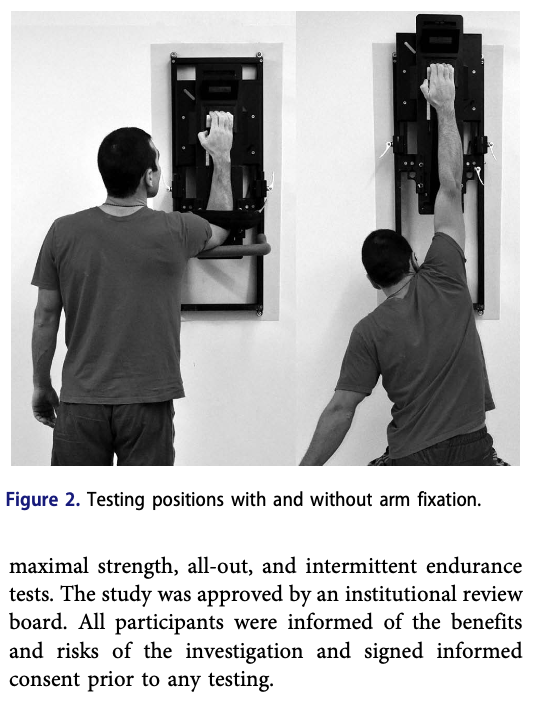
Finger force with arm fixation, the shoulder and elbow were both positioned at approximately 90 degrees and the arm was stabilized.
Finger force without arm fixation, the shoulder was approximately 180 degrees overhead and the elbow extended. This allowed the climber to pull through the upper extremity in a position more similar to hanging from a climbing hold.
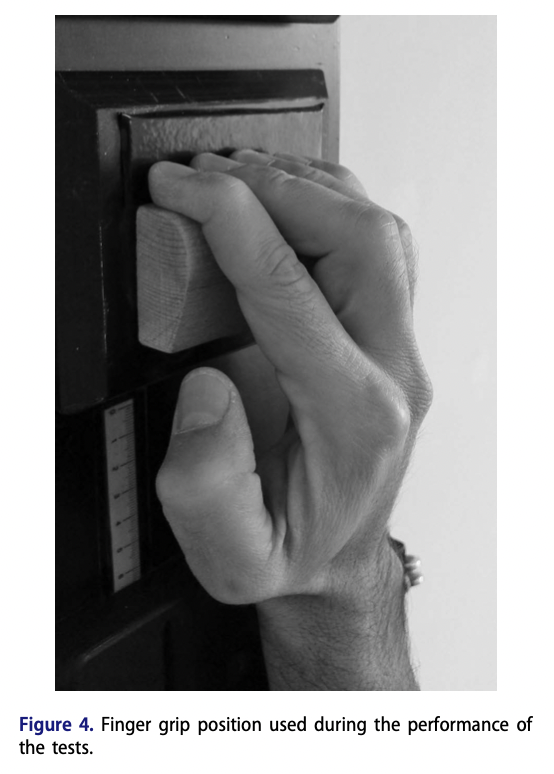
The protocol used a 23 mm climbing hold, and subsequent reviews describe the testing grip as an open-finger position without thumb engagement.
In addition to maximal force, they also measure a 30-second all-out test, rate of force development, force loss, and an intermittent endurance test.
The intermittent protocol used 60% of maximal voluntary contraction with an 8-second contraction and 2-second recovery period.
A smaller group of nine climbers completed the repeat testing used for several of the reliability analyses. That small reliability sample is worth remembering when interpreting the results.
Did fixing the arm make the strength test more reliable?
Slightly, yes. Max strength testing with the arm fixed produced an ICC of 0.94, compared with 0.88 without arm fixation. Both values are pretty good, but the fixed position was more repeatable. The tradeoff was force production, but I’d argue that the fixed position likely is a more accurate measure of finger concentric force.
With Arm Fixation: 484 ± 112 N = 108.8 ± 25.2 lb = 49.4 ± 11.4 kg
Without Arm Fixation: 546 ± 132 N = 122.7 ± 29.7 lb = 55.7 ± 13.5 kg
So fixing the arm reduced the force produced by approximately 62 N = 13.94 lb = 6.32 kg on average. I would argue this as representing that the fixed-arm position is a "purer" measurement of the finger flexors. It reduces the climber's ability to change body position and/or contribute force through the shoulder and trunk.
It definitely demonstrated that the fixed position was more repeatable, while the unrestricted position produced more force.
Which position was more related to climbing level?
Interestingly, the less-restricted position performed better here.
For sport climbing, maximal strength without arm fixation had an r² of .48, compared with .42 with arm fixation.
For bouldering, the difference was larger: r² = .66 without fixation versus r² = .42 with fixation.
In this sample, therefore, maximal force produced in the overhead, extended-arm position had a stronger relationship with climbing ability. Here’s an example video on an unconstrained arm position.
That makes sense conceptually. Climbing rarely asks the finger flexors to function independently of the rest of the upper extremity.
But this also shows why we need to distinguish between testing finger force and testing a climbing-specific force strategy. Here’s an example video on a constrained arm position.
Depending on the question, both can be useful.
What about the 30-second all-out test?
The average force produced during the 30-second all-out test also performed well.
Reliability was high: ICC = .92 and average force was associated with both: sport climbing ability: r² = .42 and bouldering ability: r² = .58.
This is an important nuance. The results don't support that "strength predicts climbing and endurance doesn't."
Instead, it suggests that maximal force and the ability to maintain relatively high force during a 30-second all-out effort both showed meaningful relationships with climbing.
Some measurements were much less reliable
This may be the most useful part of the paper for coaches and athletes. Force and time measurements generally had good reliability. But rate of force development and fatigue index were considerably less reliable. Here’s an example RFD video in a constrained position.
Just because a force sensor can calculate a metric doesn't mean that metric is useful for monitoring an athlete. It can, but requires more oversight.
Peak force is relatively easy to reproduce. RFD is much more sensitive to factors such as:
how the contraction is initiated (pre-tension)
how onset is defined (zero force, 2kg force, etc.)
sampling and filtering (measuring unit)
athlete familiarity with the task
body position
and the time window used to calculate RFD
The same issue applies to a fatigue index. Calculating the percentage decline in force sounds useful, but if the measurement itself varies substantially between tests, small changes shouldn't automatically be interpreted as adaptation.
Does finger endurance matter?
The intermittent endurance test itself showed good reliability. A later review reported an ICC of approximately 0.89 for time to fatigue in the Michailov protocol. What performed poorly was the fatigue index used to describe the decline in force. That distinction is important because the original version of this article went too far by suggesting maximal strength was simply a better predictor than endurance.
Later research makes the picture less clear.
A 2022 study using similar finger-flexor testing found that maximal force, average force during a 30-second all-out contraction, and force-time measures during continuous endurance testing were all associated with climbing performance. The intermittent endurance measure did not show the same relationship. Here’s an example of a 30 second all-out test in a constrained position.
Different endurance tests are measuring different things, and "finger endurance" isn’t one thing.
What does newer research tell us about finger-strength testing?
A 2025 systematic review examined the reliability of climbing-specific finger-strength testing across 15 studies. Most studies demonstrated good reliability, and maximal isometric finger strength tests were particularly consistent. Across all included studies, ICC values had a median of approximately 0.86. The review also highlights something that probably matters more than choosing one supposedly perfect testing position, and that is standardization.
Tests using consistent grip positions, edge depths and measurement conditions generally produced more reproducible results. Fixed edges around 20–23 mm were common among reliable protocols, and standardized half-crimp protocols frequently produced ICC values above .90. So there isn't one universal finger strength test that every climber needs to use. There are just several reliable approaches.
The important thing is knowing what you are trying to measure and keeping the test the same when you re-test it.
What does this mean for climbers and coaches?
For maximal strength testing and monitoring, I prefer a setup that minimizes unnecessary movement and is easy to reproduce. That may mean a seated or standing force test with the elbow and shoulder standardized rather than allowing the athlete to freely hang and reposition their body.
If the question is how effectively a climber can generate force through the entire upper extremity in a climbing-specific position, then the less-restricted test may be more appropriate.
Neither is "better." They answer somewhat different questions.
For repeated testing, I would standardize edge depth, grip position, elbow angle, shoulder position, warm-up, rest between trials, chalk use, instructions, and the force variable being analyzed.
If I'm using a device such as a Tindeq Progressor, I also want the attachment height, athlete position and pulling direction to remain the same.
The device gives us the measurement, but the protocol determines whether that measurement is useful.
Correlation is not prediction
The relationship between maximal force and climbing grade does not mean a finger strength test predicts how hard someone will climb, or whether increasing that number by 10% will produce a proportional increase in grade.
These are cross-sectional associations. Strong climbers tend to have stronger fingers, but climbing performance is more influenced by technique, morphology, movement efficiency, power, endurance, tactics and years of climbing experience.
A finger-strength test measures one component of performance.
Practical takeaway
The strongest message from this study isn't that different positions are better or worse. It is that a good testing protocol needs to match the question being asked.
If I want a repeatable measure of maximal finger force, I want a highly standardized position with as few unnecessary degrees of freedom as possible.
If I want something more representative of whole-body climbing force production, I may intentionally allow more freedom.
If I'm tracking an athlete over time, consistency of the protocol matters more than chasing whichever testing variation currently has the highest correlation with climbing grade.
That is what makes testing useful. Not producing another number, but producing a number we can compare later.
References
Michailov ML, Baláš J, Tanev SK, Andonov HS, Kodejška J, Brown L. Reliability and Validity of Finger Strength and Endurance Measurements in Rock Climbing. Research Quarterly for Exercise and Sport. 2018;89(2):246–254. PMID: 29578838.
Maciejczyk M, Michailov ML, Więcek M, et al. Climbing-Specific Exercise Tests: Energy System Contributions and Relationships With Sport Performance. Frontiers in Physiology. 2022;12:787902.